

The goal of this research is to improve wildfire risk management at WUI and to enhance preparedness to climate change consequences by developing the fire simulation technologies.
Target 1: To create situation picture of available data sources and competences in Finland. Plan for future.
Target 2: To develop capability to simulate Finnish forest fuels ignition and combustion now and in future climate scenarios. Focus is on CFD (FDS) simulations.
Target 3: Capability to generate models of fuel mass and class distributions from the remote sensing data.
Project members
1) Aalto University: a) Fuel characterization and development of fire spread model
(Project Supervisor and leader – Prof. Simo Hostikka, Project member – Dr. D. Shanmugasundaram)
b) Particle cloud model creation based on LiDAR data
(Project leader – Prof. Miina Rautiainen, Project member – Dr. Aarne Hovi)
2) Häme University of Applied Sciences – HAMK: Choice of fuel selection
(Project leader – Dr. Henrik Lindeberg)
3) Natural Resources Institute Finland – LUKE: Sample collection and choice of fuel selection
(Project leader – Dr. Ilkka Vanha-Majamaa, Project member – Dr. Ekaterina Shorohova)
4) External Collaboration: Western Norway University of Applied Sciences: Prof. Maria de Las Nieves Fernandez Anez
Fuel characterization- TGA and cone calorimeter experiments
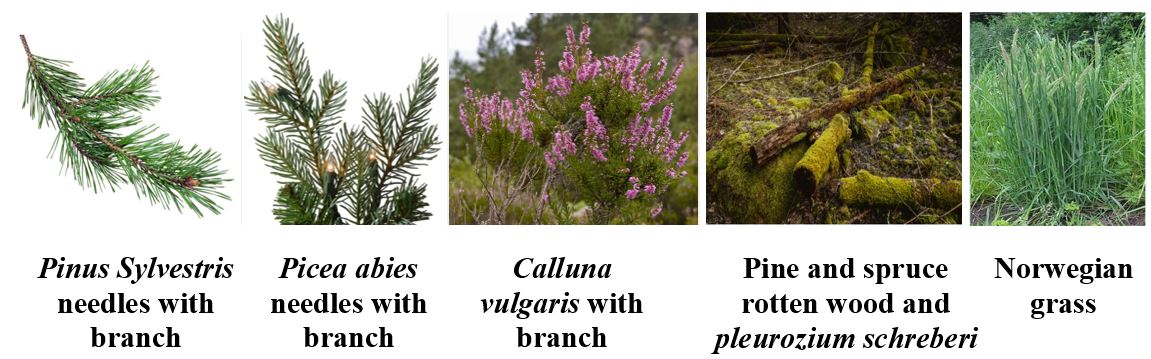
The goal of the research project is to characterize five different fuel particulates from Scandinavian forests, formulate pyrolysis models and validate them using laboratory-scale cone calorimeter and fire spread experiments. Model development also includes the creation of a particle cloud description from remote sensing data. To develop a pyrolysis model, fuel characterization (TGA and cone experiments) were carried out for the following live and fresh fuels:
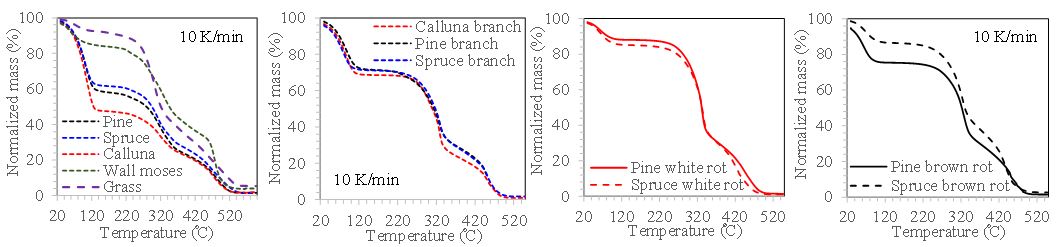
- Thermogravimetric analysis (TGA) was conducted in an air environment at a small scale to investigate the thermal decomposition behaviour at three different heating rates of 10, 25 and 50 K/min.
- Arrhenius parameters for pyrolysis and char oxidation reactions are estimated using FDS tool
Cone calorimeter experiments are essential for modelling the pyrolysis of porous forest fuels because they provide heat release, mass loss and ignition data at the material scale under well-defined external heat fluxes that are representative of fire conditions. These measurements are crucial for calibrating and validating the sub-models of pyrolysis used in physics-based fire simulations, including reaction rates, the heat of pyrolysis, and char yields.
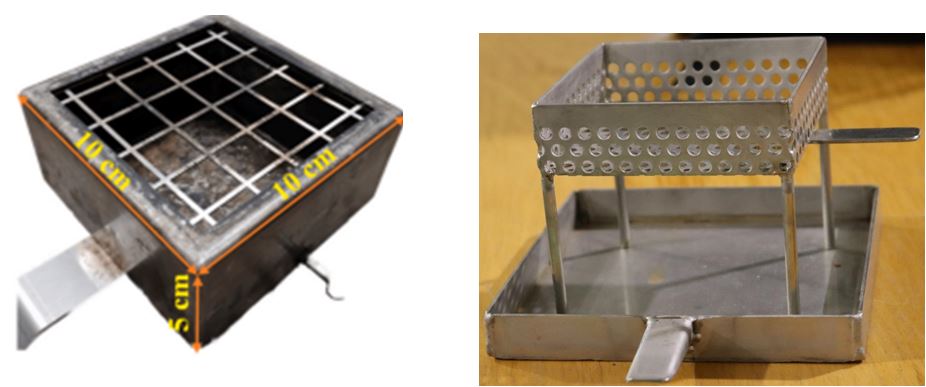
Using conventional solid holders in cone calorimeter experiments can suppress gas transport and distort how highly porous forest fuels burn. This results in non-representative pyrolysis parameters. Therefore, it is particularly important to use a porous sample holder for the selected fuels, as this preserves natural aeration, permeability, and internal heat transfer pathways, which have a strong influence on devolatilization. Consequently, all the cone calorimeter experiments were carried out in this work using a new porous stainless steel sample holder with an opening area of 50%. The length and width of the sample holder are 10 cm, whereas the height is 3 cm.
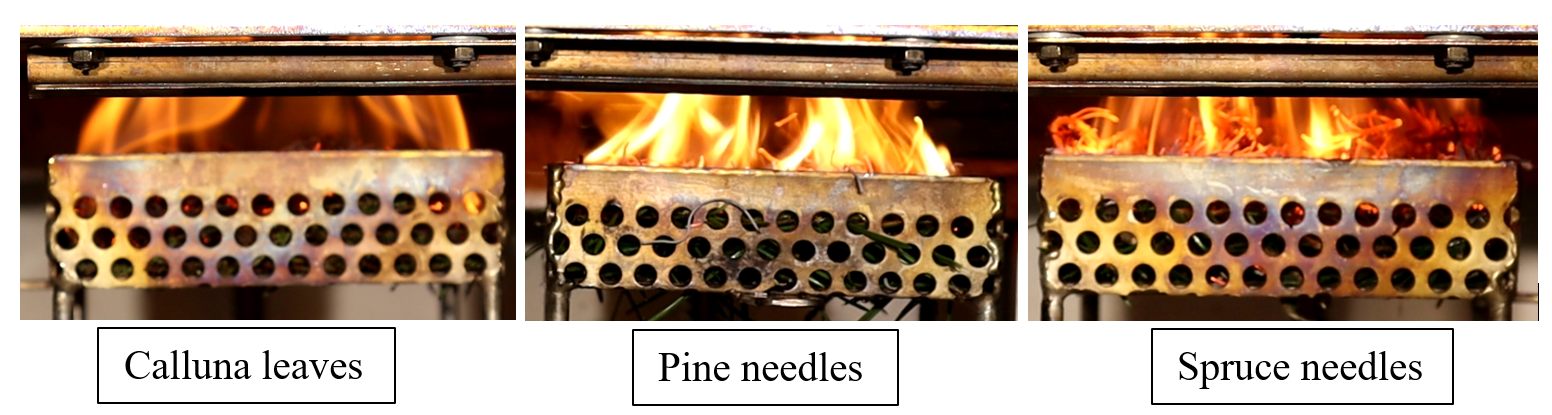
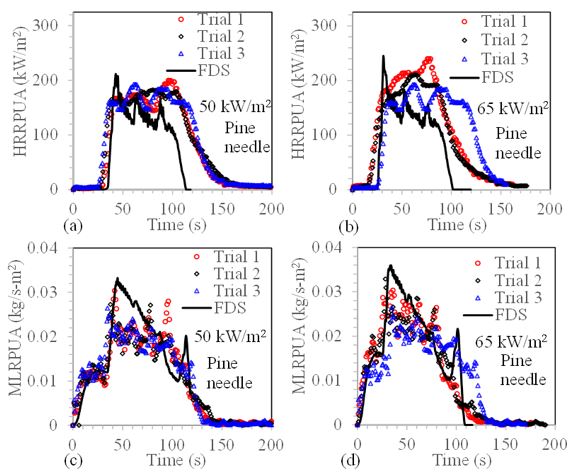
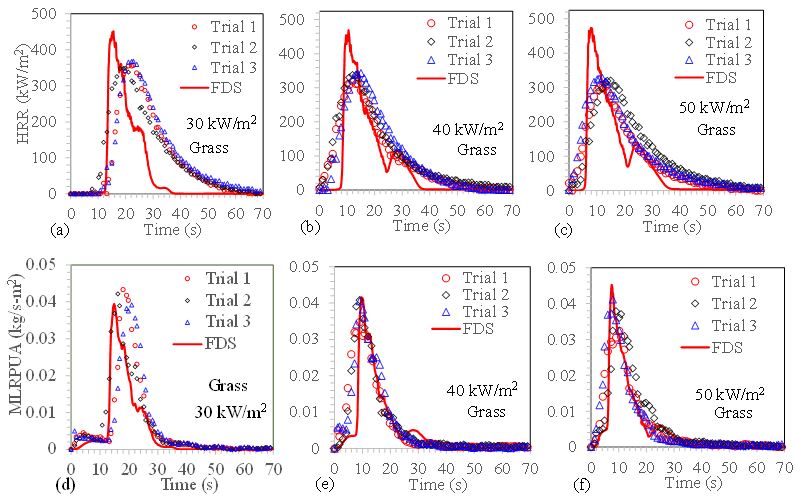
- Experiments conducted at two different external heatfluxes (ranging from 35 to 65 kW/m2) and two bulk densities (ranging from 30 to 65 kg/m3)
- Measured Heat Release Rate Per Unit Area (HRRPUA) and Mass loss rate per unit area (MLRPUA) were used to validate developed pyrolysis and char oxidation models.
Particle cloud model
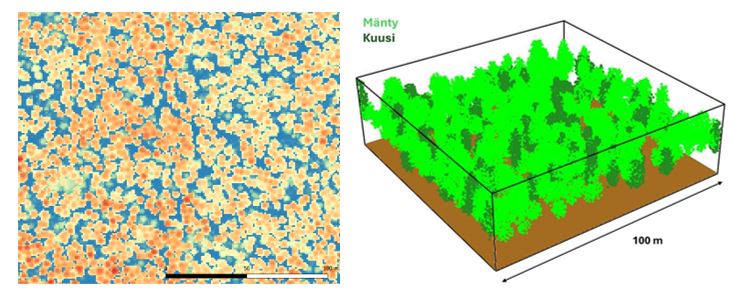
- To reconstruct forest canopy structure for fire modelling in FDS, physics based approach that uses airbonrne LiDAR data is employed to model the spatial distribution of combustible materials in the tree canopy.
- Properties of forest floor vegetation are inferred indirectly from forest inventory data.
Visible research output
Conferences
- 1) Shorohova, E., Vanha-Majamaa, I., Lindberg, H., Shanmugasundaram D., Hostikka, S., The burning question of a boreal biodiversity hotspot- coarse woody debris, IBFRA, Canada, August 2026 (Accepted).
- 2) Shanmugasundaram D., Shorohova, E., Vanha-Majamaa, I., Lindberg, H., Aarne Hovi., Miina Rautianinen, Hostikka, S., Modelling of Scandinavian forest fuels for wildfire simulations, NFSD, Denmark, August 2026 (Accepted).
Work in progress
- Design and fabrication of lab scale fire spread apparatus
- Pyrolysis modelling and validation of forest fuels using FDS
- Validation of developed particle cloud model
Funding
The research is funded by the Finnish Fire Protection Fund (Palosuojelurahasto).