The Thematic Network on Arctic Sustainable Arts and Design (ASAD) from the University of the Arctic, an internationally connected platform for Arctic art and design education, research, and mobility, has included the MAST Network in its annual review. The network brings together initiatives that advance contemporary and innovative practices in teaching, learning, research, and knowledge exchange in the fields of arts, design, and visual culture education.
MAST is highlighted as a project that explores Indigenous and art-and-design ways of knowing through making. The third MAST workshop, to be hosted by Umeå Institute of Design in June 2026, is also featured as a key activity to follow in the coming year.
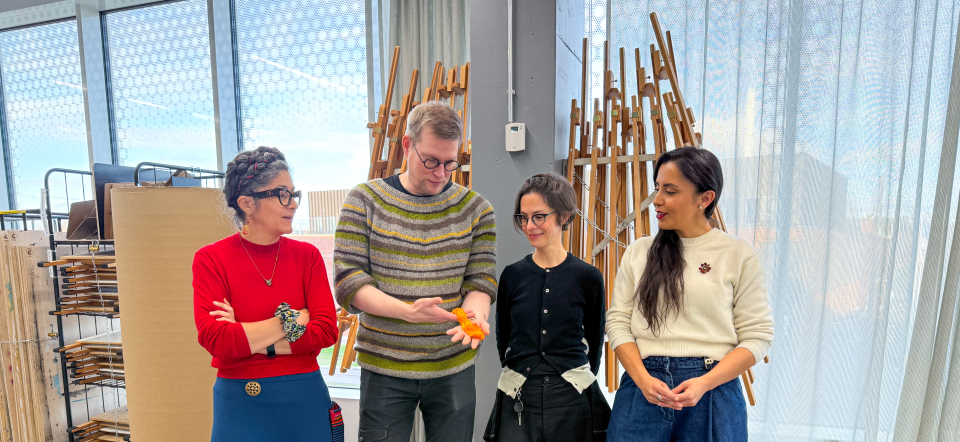
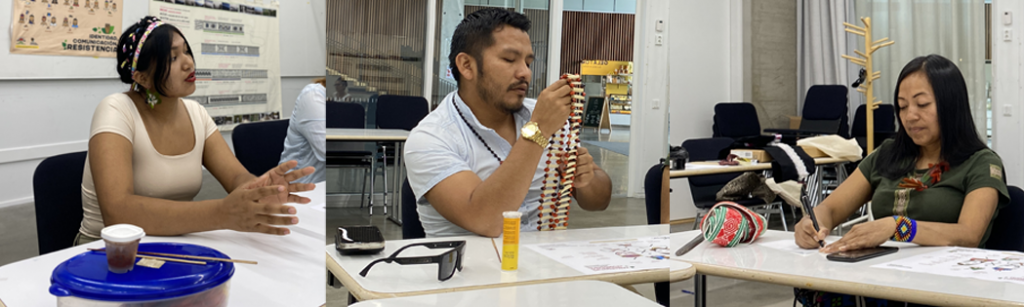
From the left: MAST participants Andrea Botero, Samuel Valkeapää, Julia Valle Noronha and Nathaly Pinto. Photo: NordForsk (2025).
NordForsk has recently highlighted the work of the MAST network in a short piece reflecting on how design practices and indigenous perspectives come together through creative, material, and collective forms of knowledge building and sharing. The note describes how, in MAST workshops, knowing through making, dialogue between the Global North and South, and embodied practices open spaces for learning across territories, disciplines, and knowledge traditions, while underscoring the network’s commitment to connection and collective support for indigenous knowledge production through cross-institutional collaboration.
By Nathaly Pinto and Andrea Botero, Design Department, Aalto University, Finland.
In a gathering called Conversando, haciendo y conociendo (nos) (Talking, doing and getting to know (us)), we explored ways of knowing through making, guided by Amazonian knowledge bearers/researchers. Local and Amazonía-related researchers and designers joined to exchange experiences grounded in practice, engage in dialogue across indigenous and non-indigenous knowledges, and strengthen ties across South–North territories.
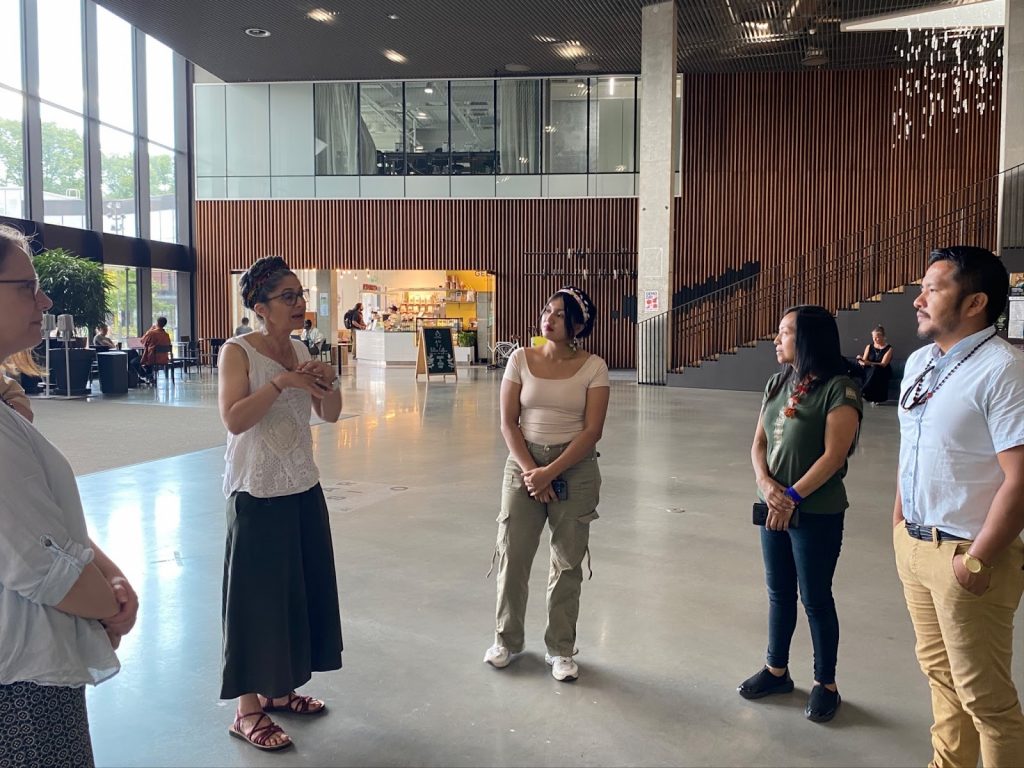
Hosted by the Department of Design at Aalto University in Espoo (Photo 1), just outside Finland’s capital on the country’s southern coast, the gathering brought together a diverse group of actors connected to Amazonian research who were in Finland for the XV SALSA Biennial Conference 2025. Building on the conference’s international convening around co-creation and (de)colonial practices in Amazonian research, the post-conference gathering extended these dialogues, deepening exchanges around making practices and materials.
Photo 1: Researchers Susana Chicunque, Efrén Nango, Lizbeth Tanguila, Andrea Botero and Tuija Veintie at hall of School of Arts, Design and Architecture, Aalto University, August 2025.
The gathering focused on indigenous pictograms as complex image systems that provide technological and cognitive support to processes of knowledge-building, an issue explored over time through collaboration between indigenous co-researchers and Aalto researchers. It unfolded as a multi-activity day, creating spaces for dialogue and reflection while actively engaging in pictogram making.
The gathering
The one-day gathering was structured around two sharing circles, where indigenous speakers and makers shared their practices, with a communal meal in nature bringing the whole group together. The sharing circles were led by Susana Chicunque of the Kamëntšá people from the Colombian Andes, Efrén Nango of the Shiwiar nationality, and Lizbeth Tanguila of the Kichwa nationality from the Ecuadorian Amazon, and took place both in Aalto Design Department’s classroom and in natural areas around the campus. We used sharing or conversation circles as a collaborative method rooted in indigenous knowledge-transfer traditions and dialogical approaches, where participants come together in a circle to exchange experiences, insights, and perspectives while exploring a device or practice.
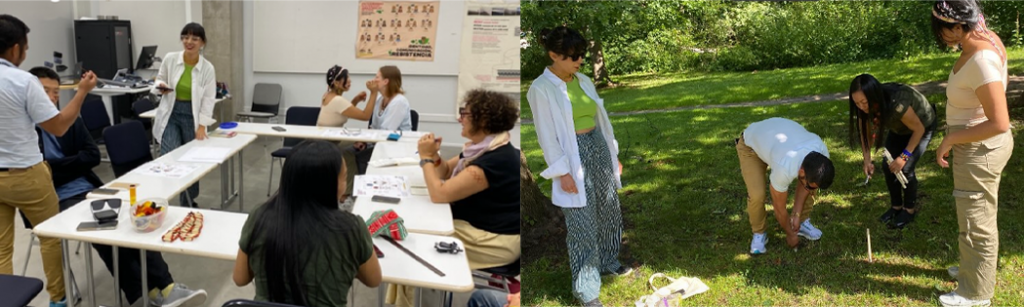
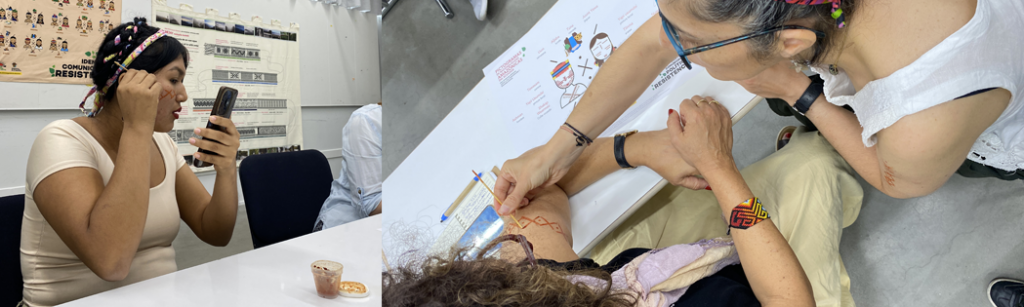
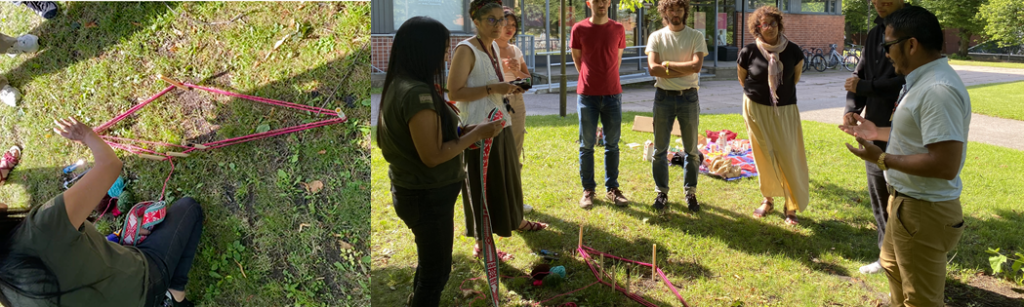
Indoors, the classroom was used to create and learn from pictograms drawn from facial painting designs practiced by Shiwiar and Kichwa nationalities, employing natural dies, projectors for large-scale displays, and walls for exhibiting printed posters and fabrics. Outdoors, the land was incorporated into the process of weaving and discussing pictograms present in the tšombiach (woven sash) woven by the Kamëntŝa people of Colombia, allowing participants to engage with and connect to the late summer of the territory, as the meeting took place in August 2025 (Figure 1).
Figure 1: Participants engaging in sharing circles and indigenous research practices in the classroom (left), in nature (right).
By transiting between talking and making, participants collectively reflected on indigenous histories, methods, and epistemologies, weaving dialogue and practice into a shared learning experience.
Sharing circle 1: Visual knowledge systems in facial painting
Lizbeth, Efrén, and Susana opened the first sharing circle in the classroom by presenting elements of the garments they had brought: the tawasam (Shiwiar crown made of toucan feathers), shakap wearmau (Shiwiar crossed collar made of Amazonian seeds and animal bones), rinrina (Kichwa feather earrings), and the Kamëntŝa tšombiach (see Figure 2). This helped attune the group to the nuances of tangible material culture, especially as the indigenous speakers consistently highlighted each object’s connections to the environment, history, and cultural knowledge tied to specific territories.
Figure 2: Liz explaining achiote, Efrén showing a tawasam and Susana next to her tšombiach.
Lizbeth and Efrén then introduced us to the pictograms used in facial painting. While showing the dyes and tools used in their application, they explained how these dyes are prepared in their cultures: achiote (from the seeds of the achiote tree) among the Kichwa, and karawir among the Shiwiar (a mixture of vegetal dyes). Their explanation highlighted the land knowledge embedded in these practices, including the understanding, care, and respectful use of the plants involved, as well as the methods for obtaining and preserving the dyes.
They then moved to the application. Lizbeth, a young woman in leadership formation, painted awina (pictogram designs) on her face with achiote (Figure 3). She drew crossed figures and dots, representing a meeting point or resembling crossed jaguar whiskers or anaconda skin, symbols of connection and respect appropriate for the occasion. She added that elders describe awina as a form of science that conveys detailed information, such as expressing thought and organizational capacity when a sun is painted on the forehead.
Efrén then applied a facial design to one participant and invited others to try it themselves (Figure 3). Speaking as an attained indigenous leader, he reflected on pictograms from a historical perspective. While explaining different uses of facial designs for war or collective decisions meetings when his nationality was forming, the roles of the people who prepare and wear them, and how those uses translate into political meetings now with other nationalities or other worlds.
While making pictograms with dyes, we experienced and learned from embodied ways of remembering and passing knowledge of communities. In this practice, visual materials and systems helped us engage in sense-making otherwise, by exploring these particular research skills and materials.
Figure 3: Lizbeth Tanguila doing awina on her face (left). Participants engaging in body pictogram making.
Sharing circle 2: Beautiful learning through weaving the tšombiach
For the second sharing circle, the group gathered outdoors under a tree. Susana opened the session by assembling a warper placing wooden sticks in the ground to form a diamond shape, a version used to create the warp that is needed before starting to weave a tšombiach (traditional belt or sash), adapted here for teaching. Using a finished tšombiach, she explained how this woven sash serves multiple interconnected purposes: protecting the womb, regarded as a sacred space for the creation of life; carrying babies; and functioning as a belt to secure clothing, and how these creation processes start already during the warping. She emphasized that although there are these ‘practical’ functions, the making of the sash is not product-oriented but a spiritual and cultural practice, often carried out collectively by women as a way of creating knowledge and strengthening social bonds.
Then while warping, she started to tell how this whole weaving practice allows Kamëntŝa woman to tell their personal and collective stories, through symbolic patterns. Each pattern is a pictogram or ideogram that tells a story, such as the shin ac (sun), joashkòn (moon), or bejay (water). By weaving the pictograms, wisdom and history are narrated and materialized into a tangible object. She had previously prepared the wool for the warp and showed us the colors hold symbolic meaning. Susana clarified that the weaved designs are not based on a written guide; instead, they are passed down through generations of oral tradition, memory and reference to the surroundings. Efrén noted that in this way of learning, the learner is not forced to absorb something foreign but instead experiences and reflects on the learning through direct connection and personal interpretation (Figure 4).
Figure 4: Susana starting to warp the threads for a tšombiach (left). Participants reflecting together on the practice (right)
“It is not the same as having paper copies that show you how to do it” Susana highlighted, when you pass down knowledge from person to person, you pass care, bonding with nature, the spirit of your stories. “Enseñas bonito” (you teach beautifully), and then you can learn beautifully.
Beautiful learning expanded our understanding of indigenous research capacities grounded in human–material–territory relations, prompting critical reflection on the relationship between research documentation and the embodied transmission of knowledge. Listening to Susana invited us to reconsider where and how cultural, aesthetic, technical, and scientific production occur; beyond the classroom, laboratory, and university.
Through embodied engagement with indigenous ways of knowing and making, we learned not only about the materials and techniques but also about the relations that sustain them across territories. These shared practices deepened our understanding of knowledge as relational, situated, and continually made through encounter. In doing so, the gathering strengthened our translocal connections, weaving ties between Amazonian and Nordic contexts and reaffirming our commitment to dialogue across lands, languages, and research traditions.
Importantly, this collective experience offered a moment of attunement, helping us refine our participatory and making-based methodologies in preparation for the next MAST Network workshop at Aalto, where we will further explore making knowledge: using land-based dyes and colors to explore visual materials and systems that sustain memory and transmit knowledge within communities.
The network is organizing a workshop on 14–15 November, hosted by the Design Department at Aalto University, Finland. This workshop will center on making knowledge: using land-based dyes and colors to explore visual materials and systems that sustain memory and transmit knowledge within communities.
Some activities are reserved for participants and network members due to limited capacity. However, presentations by researchers on dyes, digital fabrication, and pictograms as cognitive devices, as well as the closing exhibition, are open to the public.
We warmly invite you to join the public activities taking place onsite (highlighted in yellow in the program below) and to reflect with us on indigenous research practices and other ways of making knowledge.
If you plan to attend, please register via this link:
By Hanna-Máret Outakoski, Sámi allaskuvla/Sámi University of Applied Sciences, Oahpaheaddjeoahpuid goahti/Department of Sámi teacher education, Norga/Norway.
Cindy Kohtala, Umeå University, Umeå Institute of Design, Sweden
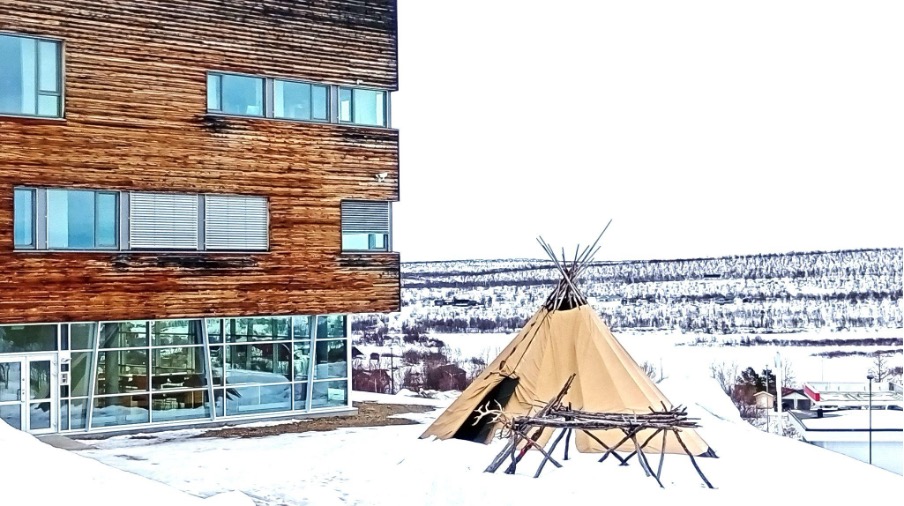
In our first workshop, called Making Territories, we were hosted by Sámi allaskuvla, Sámi University of Applied Science in Kautokeino, Norway, see Photo 1. Sámi allaskuvla is located at the heart of Guovdageaidnu/Kautokeino municipality in Finnmark, Norway. This is a territory of reindeer herding tradition that is still following the seasonal movements of the reindeer herd. This is also where the Sámi language is the main medium of communication in the worklife as well as in the private life of the people. Traditional knowledge is still a part of the everyday life of people, as is making and crafting.
Photo 1: Sámi Allaskuvla/University of Applied Sciences in April 2025, by H.-M. Outakoski.
As our meeting took place in April 2025, the reindeer herders of the area were moving their reindeer to summer grazing lands. The spring move was accompanied by strange weather that had continued from the autumn, keeping the hard crusted snow on the ground also up on the mountaintops. The unpredictability of weather and snow conditions, and threats to the sustainable future of the core Sámi livelihoods, were trending as a subject in many academic talks and as a main topic of the coffee break discussions during that spring at Sámi allaskuvla. In many ways our first network meeting on making knowledge on sustainable transformations (MAST) seemed to be at the right place at the right time.
The workshop
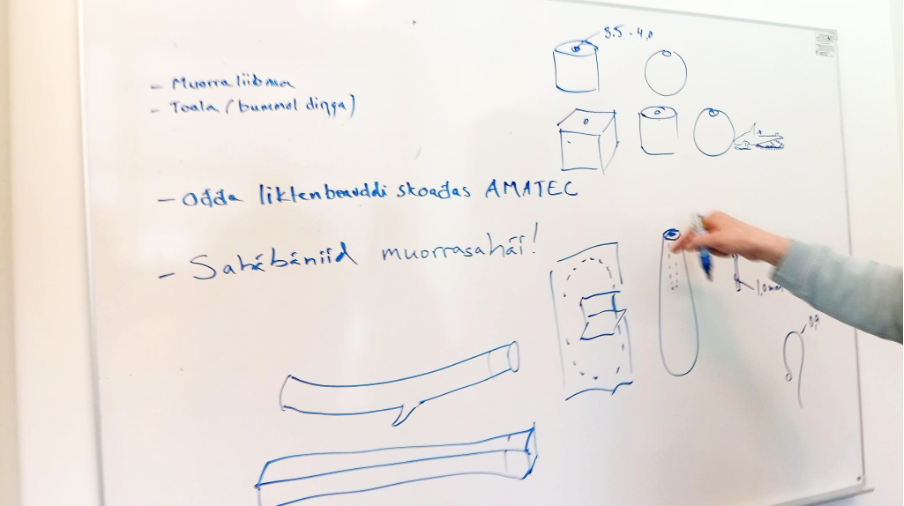
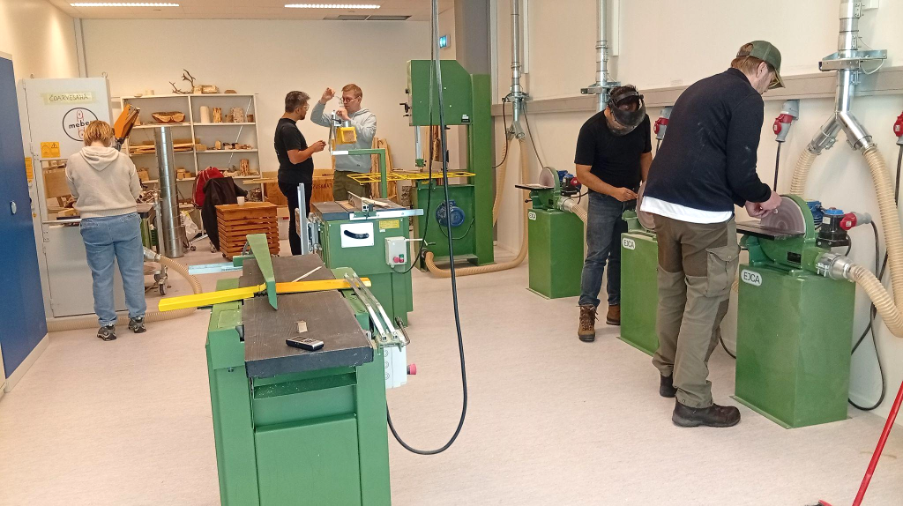
The three day workshop was structured to encompass short introductory and informative lectures; working hands-on with reindeer-bone porcelain, reindeer antler, and wood, under the guidance of experts; and ongoing discussions while making and presenting, see Photos 2 and 3. We were fully focused on learning about – through talking and doing – duodji and the knowledge and experience that duodji embeds and embodies. (Further reading: Duodji as a Starting Point for Artistic Practice)
We then drew together our learnings and experiences by putting forward first reflections in one round and then deepening the insights and commenting on others’ in a second round. The discussion wove together the interface of language, embodied experiences of making, and knowledges of landscapes, conditions, soil, environments, histories and materials. We led ourselves through a rich story of the future of things, the role of objects in society, and a more profound understanding of “socio-materiality”.
Photo 2: Researcher Samuel Valkeapää drawing and explaining the steps of the making process that support localities. Photo 3: Researcher Samuel Valkeapää guiding workshop participants during the reindeer antler and wood crafting session.
Sites and materials
While the term ‘care’ is vulnerable to overuse and superficial understanding in today’s academic environments, we came to know and feel how care for sites, soil, land and localities manifests in care for materials and things. In highly urban and hypercapitalist, consumerist contexts, such ways to care have been forgotten or have been made invisible and undervalued. In many cultures there may even no longer be words that carry such practices in language as a technology.
Let’s consider the example of luonddu oassi: Professor Gunvor Guttorn explained this concept by telling us a story of her father, who had taught her about antlers. It was important to leave antlers that had already fallen on the ground to stay on the ground if they had been there for some time. “Nature’s share” means that one should give back to nature what is meant to be given back. It is then up to the person to decide and when this is appropriate and when it is not needed.
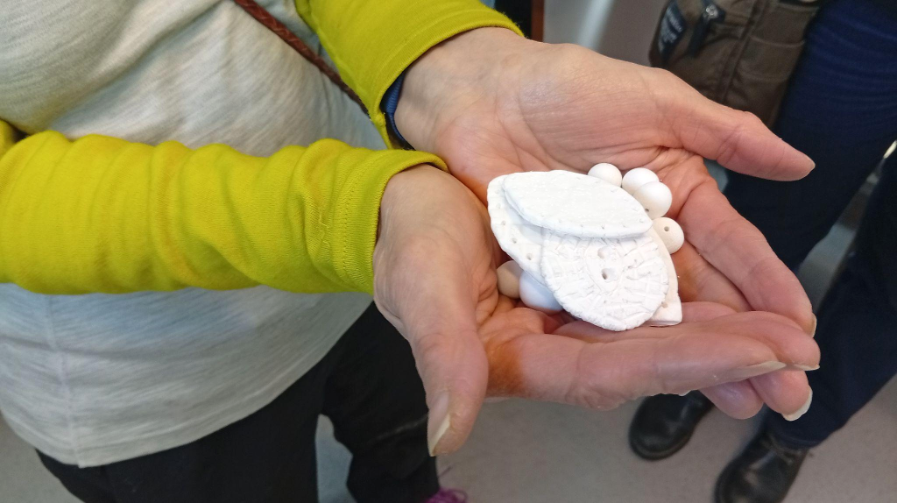
We also worked with reindeer bone porcelain, and ceramist researcher Mirva Kosonen, a master’s student at Aalto University, coached us on how to care for the material and how to make forms with it that respects its nature, see Photo 4. Through her lecture, watching her work and having her guide us in understanding the material, we had flickers of memory from our ancestors having lived with mountains and stone turned to dust and soil and clay, over thousands of years. In a way, some of us felt that working with this novel material (china of reindeer bone rather than cow bone) connected us more deeply with the profundity of nature and the earth, human endeavour, and even further back to the creation of the continents. Deep Time.
Photo 4: Caring and working on the reindeer bone china.
Language as an interface
Language and terminology were very much at the centre of our meeting that brought together researchers and artists from four Nordic countries. Many of us had roots in cultures and places outside the Nordics. The common language for communication during the network meeting was English. However, the conversations between individuals showed a much more versatile take on communication as different languages were accompanied by embodied non-verbal communication, pictures and drawn examples, non-verbal hands-on instructions on how to work on certain materials, emotional signals, and much more.
During our workshop, 16 central Northern Sámi terms or concepts were mentioned (some of which are mentioned also in this text). Most of the time, the Sámi concepts were not accompanied by a translation or explanation, but the Sámi participants used them naturally as parts of speech when speaking about the Sámi worldviews, materials, values, nature, arts and crafts. Presentations and talks given by the Sámi representatives and leaders of the Sámi crafting sessions also emphasized that relations and relationality are at the centre of Sámi ontologies and epistemologies. This view obliges the researcher, or the artist, to consider responsibilities toward the lands, the materials, and the powers in nature, and to respect the ways procedural and process-oriented knowledge is generated, stored, and mediated. During our final sharing session, one of the participants’ wishes was to get a deeper understanding of the central Sámi concepts to be better prepared to meet the expectations and needs of the future research collaborations with the Sámi academic and non-academic communities.
A Safe Space for discussions
As such space was created, we were able to understand certain Sámi terms as concepts without verbal definitions. We were able to come to this understanding through the discussions and making/creating together. In the meetings, we were open to sensitive questions at the same time as we were committed to caring for each other as researchers, practitioners, craft-makers (duojár), academics, and teachers. In many of the conversations, this kind of opportunity to meet and discuss matters from different perspectives was seen as an example of methods that can be used for healing academia. We also agreed on having several views on what the need for healing was, depending on the disciplines and the many research perspectives that the group members represented, as we come from different research contexts.
During our first network meeting, the goal for the meeting was to reach a state of successful exchange of ideas. A Sámi term, that was introduced early on during the network meeting, was “gulahallan”. This word has morphological parts that refer to hearing and making someone hear, a kind of reciprocal relationship and a complexity that tells us that the meaning of the word cannot be so simple. Gulahallan is also mentioned as the first Code of Ethical Conduct in the freshly published Ethical Guidelines for Research Involving the Sámi People in Finland (nbnfioulu-202405294076.pdf). In that publication gulahallan is explained as reciprocal communication and engagement. Here, we could describe gulahallan as being about having conversations and discussions, keeping in touch, with the goal of sharing insights as well as being open to other people’s understandings and views. This kind of meaning making process can also be extended beyond human-to-human conversations including, for example, the processes of reading and understanding one’s environment. English words such as communication, dialogue, mutual comprehension, and negotiation of meaning indicate some of the joined meanings of gulahallan, although they seldom extend to situations beyond human-to-human interactions. Successful gulahallan means that there has been a state or process of coming into a mutual understanding of things, even if it entails that some views are recognized and accepted as being opposite to each other. A non-successful gulahallan can be any kind of communication where, for example, the conversation partners either do not manage or want to create a mutual understanding of things, or they are not in tune with the goal of gulahallan in the first place, the direction of the communication is a one-way route, or there are other, perhaps external, reasons why the gulahallan does not succeed.
Time and temporality
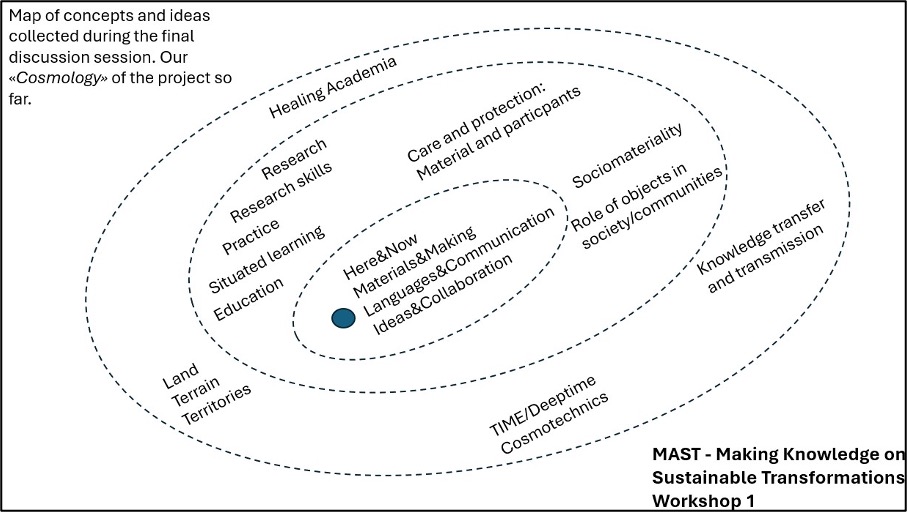
This was another central theme that became evident, as our discussions led us to a further illustration of what we saw as the ‘cosmology’ of our overall project. We saw ourselves in a timespace where we are “here and now”, yet connected through hundreds, even thousands of years in the past, through practices and materials, to visions of the futures we wish to see. This was possible especially through working with reindeer bone porcelain and antlers and the connection of the human, community, livelihood, animal and soil, as we indicated earlier. Gunvor in turn guided us into another time dimension where materials are collected and their interrelations cared for, over long periods of time. (Want to read more about Deep Time and temporality? See e.g. The Deep Time Walk – How Effective Is It? and Deep history and deep listening: Indigenous knowledges and the narration of deep pasts.)
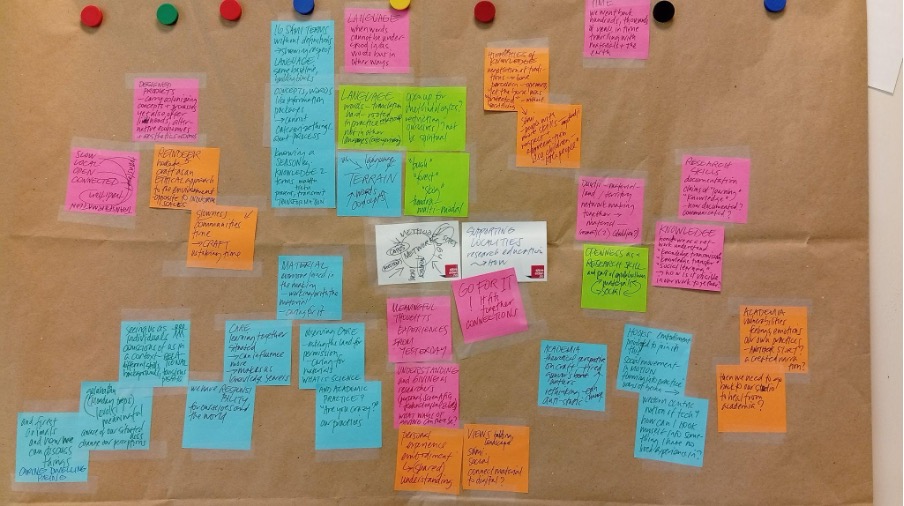
Photo 5: Idea map resulting from the final group discussion of the network meeting. Figure 1: The results of the final discussion session presented as a “Cosmology” of the first network meeting.
At the end of the workshop we collected and synthesized our ideas and insights into a “research map”, see Photo 5, which became something of a “Cosmology” of the first meeting, see Figure 1.
Final thoughts
Through our work, we address research, education and practice and the importance of care ethics, which informs the research skills we wish to foster throughout the project. Through this we see making practices as part of a healing academia by which we know better how to care for land, materials and other relations.
Interestingly, given our attention to language, we did not use the word “territory” very often, even if the title of the workshop was “Making Territories”. Instead we referred to terrain, land, landscape and other relational terms that do not carry the baggage of a damaging colonial history wrought by the global North. In fact, this is a compelling point to address in future in our network, in North-South dialogue. In Latin America, territorio has been a term connected to resistance and protecting land and community from oppression (Further reading: Space, Power, and Locality: the Contemporary Use of Territorio in Latin American Geography).
If we are losing language, if words lose their meaning and techniques become tools of extraction rather than enrichment for localities, how can we regain what we need to survive and thrive in sustainability transformations? Perhaps we can make small steps together and learn in knowing-through-making.
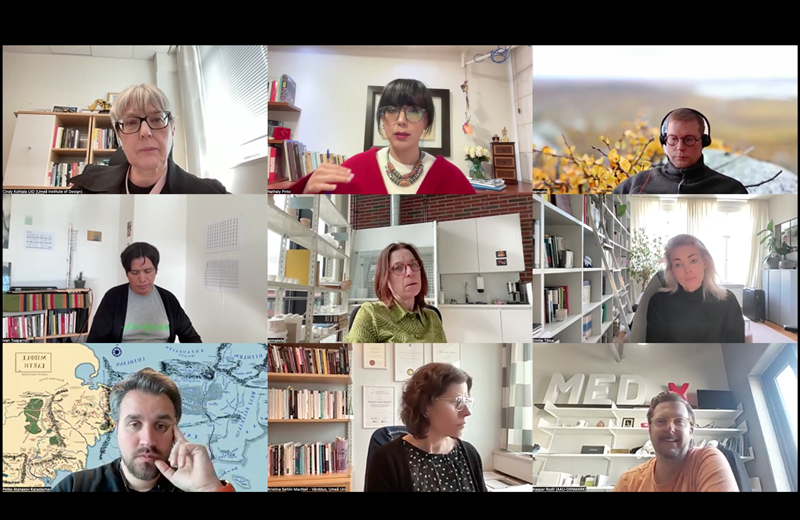
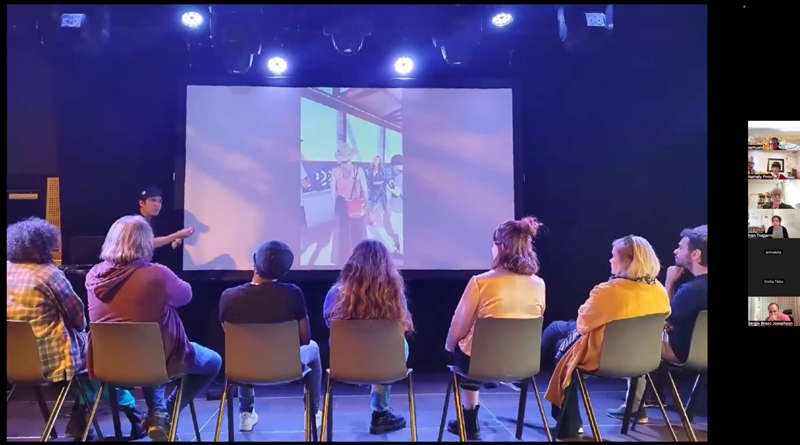
As part of our ongoing effort to nurture collaboration within the MAST network, we started giving form to sharing circles. Sharing circles, in first stance, will be online gatherings that provide a space where network members can come together to exchange expertise, reflect on shared themes, and engage in open discussions about common motivations and concerns. The sharing circles are thought to complement the in-person workshops by offering continuity and maintaining momentum between physical meetings. They create opportunities for deeper dialogue, mutual learning, and collective sense-making across distances.
For the first sharing circle, we had the presentations of Ivan Txaparro and Nathaly Pinto, who discussed part of their work:
Ivan presented his work with Indigenous communities in Argentina, Colombia, Mexico, and the United States. His practice brings together participatory design and applied ethnomusicology, with a focus on methodologies that advance epistemic resistance and activism through collaborative art, music, and new media. He introduced Resonant Lab, a collective he founded that centers on activism, art, and transdisciplinary research, engaging with feminist, Indigenous, and queer epistemologies. The collective collaborates with South American communities through music, comics, and radio to craft counter-narratives. Ivan also shared his work with youth, using hip-hop and folk music to support the construction of political identity. One of the projects he highlighted, based in Colorado, addressed environmental racism by using a mobile lab to engage local communities in co-creating a song and music video as acts of resistance.
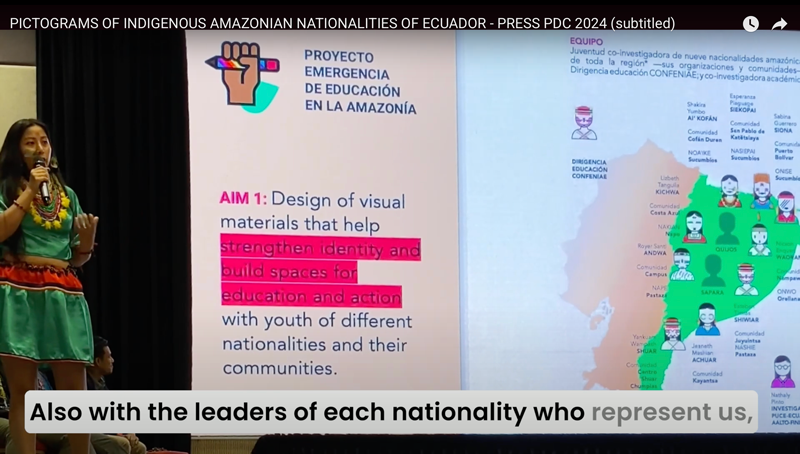
Nathaly presented a video featuring the work of an intercultural research collective, showcasing their five-year participatory research and design project with Amazonian Indigenous nationalities in Ecuador. As a designer and researcher from the Andes, she has collaborated with Indigenous communities for nearly 15 years across academic and activist spaces. The video spotlights Shakira, a young Indigenous leader who represented the collective at the Participatory Design Conference 2024, with Nathaly providing support and translation. Centering Shakira’s voice, the video offers valuable reflections and insights on conducting research in collaboration with Indigenous communities.