
Educational policy and practice course 2023
1st entry: My own ideas and my directions towards understanding Educational policy and practice.
government
legislation
digitalization
co-operation
Online education
Assessment and feedback
The most interesting topics on educational policy
- GDPR, information security, data privacy, Learning tech& user policies, University act, UAS law, AI
- commonly agreed solutions/ways of working (national or global level?, utopia?)
- Finnish Higher education institutions
- National initiative Digivisio2030: aim for shared tools and ways of working and co-operation
- admissions: commonly agreed processes, digital solutions
As I am rather educational leader than educator
working in cross-diciplinary environment I find post-modern orientation the most intereresting:
it is positive for development and full of possibilities sure it also can benefit from aspects of Critical, liberal and conservative orientations at least when it comes to creating a shared truth and common ways of working. I also acknowledge that post-modern orientation in University context is pretty obscure but my current position in IT-department gives freedom to at least try. Anything. This certainly links to organization culture but the culture in my current department allows a lot, it gives a freedom to work and to develope and to participate in every angle and corner for acchieving a fluent, national understanding and to be a enabler of cooperation.
I have contributed to the writing of some of my organizations internal policies, some of national level policies and I have worked as an Higher education expert in the development of educational policy in general.
I have also been teaching teachers, basicly I teach themes related to educational technology, the skills of which are part of recent technological development and part of the change of being as well. I have been teaching also digipedagogical skills and how assessment can influence teaching and learning in Higher education. Some how I see that I have also been a part of a team that works as a trailblazer or an innovator for our organization leading the way to digital tomorrow (future-oriented aspects as well).
Guiding and showing the way for utilizing new kind of tecnological innovations in teaching and learning is one example of my educational experience which may be result of mixing together liberal and post-modern orientation to education. My whole working career I have wanted to encourage my students to change one thing at a time and to adjust the topical developlement aspects to their own teaching taking care that they, as teachers, can maintain their own wellbeing as well as they as educators can help their students to succeed and stay curios and willing to learn more about all the possibilites of science, technology and future.
2nd entry:
Best way for me to show evidence of learning is to make syntesis or summary ppt-slide (one-slider) about the topic. Also writing news or reflective blog posts (blog platforms or eg. linkedIn) on the topics of this course could serve as evidence of my learnig.
My aim is to widen my understand about the boundary conditions, limitations and legalities of education policy, which are nevertheless reflected in the teacher’s everyday life and it should be helping not restricting teaching and learning. Usually policies are written by persons who are not teaching themselves/involved to teaching or able to reqocnize all the aspects that influences to teaching so paying the attention to these is essential when forming/developing/updating the policies.
Because I found these next questions about (economic, social, political) benefits and problems a bit confusing and being out of my focus I asked ChatGPT to help me to understand. So I asked ChatGPT to answer next questions. My own thoughts are written in Italic.
Mainly viewing education as preparation for work:
Problems: Narrows the curriculum and ignores other important aspects of education, such as critical thinking, creativity, and moral development. Generic skills and developing them during the studies is even more critical than before, being able to think wider and to understand others gives a great competitive advantage in the future.
Benefits: Focuses on developing skills that are relevant and in demand in the job market, helps students to prepare for their future careers. Being able to guess or to predict the skills needed in future itself is a huge benefit.
Viewing education as knowledge for its own sake:
Benefits: Provides a well-rounded education, helps students develop critical thinking skills, and cultivates a love of learning. Is there something to add to AI formed answer? World peace? As far as I see, the love of learning is the key message for the future.
Problems: May not directly prepare students for the job market and may not be as relevant to their future careers. Being able to apply your previous knowledge is even more important than ever before.
Measuring academic outcomes for schools and comparing the results:
Benefits: Provides accountability, allows for tracking progress and identifying areas for improvement, and helps allocate resources more effectively. But what this really proves? Spatial differences in teaching and learning? how could these be solved? We all are humankinds; we have same abilities but some how the location of the school is meaningful. How could we create the measures that are even?
Problems: Can lead to a narrow focus on test scores, neglects other important aspects of education, and may lead to “teaching to the test.” I would say that is has already done so. So how can we move forward?
3rd Entry: Educational policy and practice in Media discussion
Media discussion:
| Date | Media | Topic |
| 20.1.2023 | Iltalehti: https://www.iltalehti.fi/kotimaa/a/022626c7-ae21-4877-9789dd9574252006 | Finnish as a second language learners struggles. Not all: Ozan started to study Finnish at age of 14, now he started his doctoral studies in Finnish. |
| 18.1.2023 30.1.2023 | Yle.fi/koulutus (Finnish national news sercive, educational news page) | over 20 news: different topics: etc: school lunch, wellbeing of students, , repeat a year-rate decreases, favouri subjects in HE institutions 2023, more applicants from abroad… Finnish as a second language, |
| 19.1.2023 | Helsingin Sanomat: https://www.hs.fi/kaupunki/art-2000009333654.html | Teacher tells about the reality in classes: pupils speak rather English at schools not Finnish |
| 19.1..2023 | Helsingin Sanomat | Minister of education on learning outcomes: “it is not an educational policy solution to state that some children are the wrong kind” (cuts from education) |
| 21.1.2023 | Helsingin sanomat | Left wing (political party) wants smaller group sizes and more resources to education |
| 20.1.2023 | Helsingin Sanomat/Visio- education | Was 2020 Entrance exam reform successful? The Ode to gap year. (Essay) |
| 27.1.2023 | Helsingin sanomat: https://www.hs.fi/politiikka/art-2000009345016.html | some students with Finnish as a second language know Finnish better than those whose mother tongue is Finnish |
| 27.1.2023 | Helsingin sanomat:https://www.hs.fi/kotimaa/art-2000009355099.html | Record number of applicants in HE |
| 26.1.2023 | Helsingin Sanomat: https://www.hs.fi/kotimaa/art-2000009351580.html | ChatGPT can be used in university studies and thesis work in University of Jyväskylä |
| 27.1.2023 | Helsingin sanomat: https://www.hs.fi/hyvinvointi/art-2000009293551.html | Student-Finnish vocabulary, welbeing in focus. |
| 17-27.1.2023 | Helsingin sanomat and Aamulehti, e.g https://www.hs.fi/kotimaa/art-2000009365985.html | President elections of Tampere and Helsinki universities. e.g 19 applicants for the President of University of Helsinki, 21 for the President of University of Tampere ( current president Mari Walls, is no longer applying for the position of president of the University of Tampere) |
| 24.1.2023 | Helsingin sanomat | Interview of high school students: should we get rid of matriculation exams? |
| 28.1.2023 | Helsingin sanomat https://www.hs.fi/kaupunki/art-2000009350767.html | Kid was transferred to Finnish as second language class even he is fluent in Finnish |
| 22-27.1.2023 | Helsingin sanomat/reader’s opinion page | Multiple writings: curricula cannot be made without expertise, the teacher must understand the goals that have been set for her work, |
These two weeks have been very active (even exhausting) in published news/discussion of Educational policy and practice in Finnish media. Basicly I noticed roughly 6 kategories
- Joint admissions for HE institutions is ongoing: record number of applicants, news about favourite branches, more applicants from abroad than previous year, critisism to the renewal of admissions processes: should it be renewd again, applicants needs time for wandering and wondering.
- Debate about finnish as a second language learners , are they supported enough, need for resources and new skills for teachers
- Lack of resources in early childhood edu and in schools (or uneven distribution of resources?), we should finally hear what teachers are saying
- AI and teaching: ChatGPT allowed to use in Uni Jyväskylä, Teacher reveals how AI effect in class
- 2 viewpoint roles available: Presidents for Helsinki University and Tampere University will be elected soon
- Other issues: eg. news about welbeing(teachers and students), news about school lunch (is baked potatoes with ketchup decent lunch for vegetarians ? Serving raw fish sticks),
And what comes to the group discussion, things discussed in Finnish media are bit different than in other countries since in Finland the topical themes are applying to universities and ongoing elections but some how similar: welbeing, generic skills, resources and AI.
4th entry
- What did you find surprising in your investigation of stakeholders and supranational organizations?
Most beneficial of this investigation was co-operation and discussion with peers and getting detailed sights of how similar and still different stakeholders different participant in different nations identified. Suprising was that how similar stakeholder groups could be reqocnized and when one member of the group inserted a new stakeholder to the shared map it took only couple of second for another member to connect it to own context. All the links and connections between our stakeholders and supranational organizations gave a deeper understanding of these forces are trying to lob for the result. It was also suprising how differently supranational organizations can be considered as a whole. This still needs some efforts to be clarified.
- How did you find the two assignments?
Some how I found these 2 assingments bit frustrating, maybe it rises from my position at work. Yet, I noticed that because of these assigment I ended up for a flow and used more hours with these tasks than planned (this actually happens with every task).
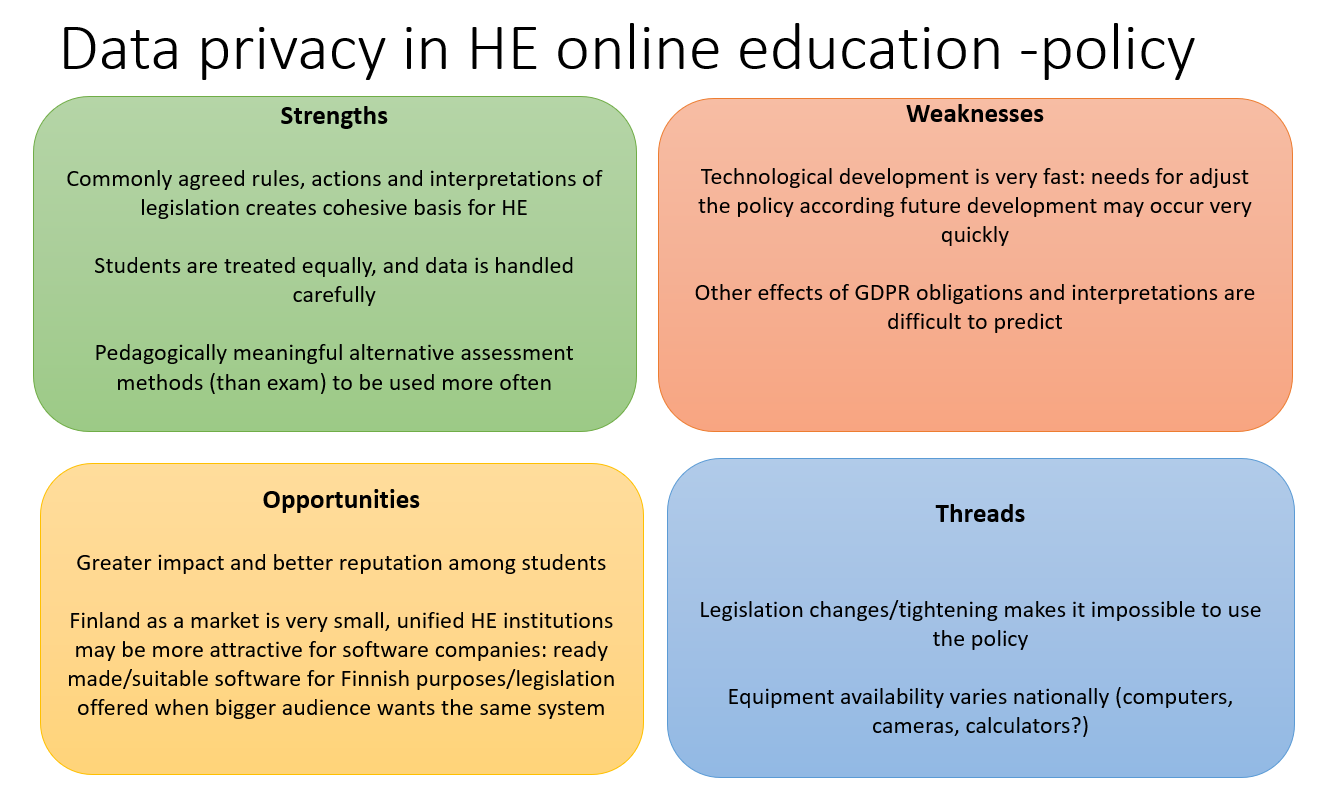
And yes, it is important to understand how other countries/EU places their policies and gives limits and boundaries but still I work in environment where university act and our national legislation gives even more strict boundaries for things we do and develope. Also Finland as a market area for EduTech is so small that only rare offerer are willing to obey our national interpretation of GDPR or our legislation in order to offer any solutions for us to use. It will need some kind of co-operations between HE organizations to be at least interesting market area for global edTech companies (in the field of proctoring/controlling).
But sure I am also glad that in Finland and in my organization, we take GDPR obligations seriously and aim for handling data as secure and protected as possible.
It is good to acknowledge that policies are interpret differently in different countries and it is good to know all the stakeholders in the field. And this way its easier to create shared and common understandin nationally in order to be able to fill the plans for e.g Digivisio2030
5th entry
SWOT analysis.
References which were used in this assignment:
Aalto University guidance for remote proctored exams: https://wiki.aalto.fi/pages/viewpage.action?pageId=170858186
Bearman, Margaret et al. 2020. Re‐imagining university assessment in a digital world, Cham, Switzerland: Springer International Publishing.
John Biggs and Catherine Tang. 2011. Teaching for Quality Learning at University (4th. ed.). Society for Research into Higher Education and Open University Press, Shoppenhangers Road, Maidenhead, Berkshire, England.
Data protection in teachings-guidance for teachers: University of Helsinki. 2023. https://teaching.helsinki.fi/instructions/article/data-protection-teachers retrieved 26th of February 2023.
Dawson, Phillip (2020). Defending Assessment Security in a Digital World, Routledge.
Educause article: Data privacy in higher education: https://er.educause.edu/articles/2021/2/data-privacy-in-higher-education-yes-students-care , retrieved 20th of February 2023.
The EXAM consortium. 2022. EXAM for students: Instructions for the electronic examination called Exam. https://wiki.eduuni.fi/display/CSCEXAM/EXAM+for+students
The EXAM consortium. 2019. EXAM an electronic exam software for higher education. https://eexam.fi/in‐english
Florence Gabriel, Rebecca Marrone, Ysabelle Van Sebille, Vitomir Kovanovic & Maarten de Laat (2022) Digital education strategies around the world: practices and policies, Irish Educational Studies, 41:1, 85-106. DOI:10.1080/03323315.2021.2022513
Remote proctoring FAQ, University of California Berkeley /Center for Teaching and Learning https://teaching.berkeley.edu/remote-proctoring-faq , retrieved 20th of February 2023.
6th Entry
Did I learn something? or rather I should ask How much did I learn!
During the course I have gained even stronger understanding over how important areas cybersecurity and data security are to the whole eductional sector.and started to make summaries and syntesis for training sessions as well.
I have also been using more time than expected in every assignment, its because I already have lot of connections, networks and data available and still I am constantly eager to learn more and understand better the topics regarding the area.
Summarizing my learnings from the course: Educational policies are way to shape our educational landscape and future. Policies must be constantly reviewed and revised. At the same time policies helps us to see how rules and legislations affects in educational context but also how to be future-wise and constantly evolving with all the needs and predictions.
Great variety of factors, aspects (political, economical, societal),, stakeholders and needs and demands needs to be understood for forming usable and reasonable educational policies.
This has been eye-opening and inspiring course but too laborous for students working full time. It has been difficult to understand different schedules offered and moodle calender is also showing tasks and assignments that are not for our class at all and that is also confusing.